
Why cold-formed steel framing outperforms wood on every metric that matters.
Cold-formed steel (CFS) framing is the structural alternative to wood. Stronger, lighter, fireproof, dimensionally stable, and engineered to a 100-year design life. Here's the full comparison — and the math on what it actually saves you.
Call +1 512 215 2816 · Mon–Fri 9–5 CT
Steel wins seven
of nine.
Nine categories that decide a build's cost, schedule, and longevity. We graded both systems against each — here's where the line falls.
Where CFS wins
- Framing schedule
- Material cost stability
- Fire resistance
- Insurance cost
- Dimensional stability
- Lifespan (100+ yr)
- Repeatability / BTR
Where wood has the edge
- Initial material cost
- Subcontractor availability
That category gap shows up in real dollars. The single biggest line item: insurance. Run your numbers on the savings calculator below ↓
Eight attributes. Two systems.
Wood framing has been the U.S. default since 1832. Cold-formed steel is the engineered alternative. Read straight across each row — the difference is rarely close.
|
Attribute
What you're comparing
|
Fig. A
Wood framing
|
Fig. B · Volstrukt
Cold-formed steel
|
|---|---|---|
| 01 /Weight | Heavy and variable. A 2×6 stud weighs roughly twice what the equivalent CFS C-stud weighs. Lumber weight varies by species and moisture content. Baseline | 40–60% lighter. Less crew. Less crane time. Lower towing weight on mobile structures. Easier to handle in tight infill sites. 40–60% lighter |
| 02 /Fire | Combustible. Ignites at roughly 400°F. Once a wood frame catches, the structure burns until extinguished. ISO classes it as Construction Code 1 — the least fire-resistive category. ISO Class 1 | Noncombustible. Steel does not ignite. ISO classifies CFS framing as Construction Code 3 (Noncombustible). In wildfire and high-density zones, that single fact changes the insurance math. ISO Class 3 |
| 03 /Insurance | Top-rate category. Frame construction is the most expensive insurance category. Premiums increase faster with age — a 25-year-old wood-framed home can cost $1,000+ more per year than its masonry counterpart. Higher premium | Noncombustible-rate category. CFS framing typically saves 10–20% on standard policies. Builders Risk can save 50% or more. Wildfire-zone savings can be dramatically higher. 10–50% lower |
| 04 /Precision | Cut on site. Tolerances negotiated. Wood is cut at delivery or in the field. Studs vary. Plates need to be shimmed. Trades absorb the variance. ±1/4" typical | Cut to ±1 mm. Numbered. Every CFS component is roll-formed from a CAD file, punched, labeled, and shipped as a kit. No on-site cutting. The crew follows numbers, not interpretation. ±1 mm |
| 05 /Stability | Warps. Shrinks. Cracks. Wood moves with temperature and humidity. That movement telegraphs through drywall over time — nail pops, hairline cracks, doors that stop closing. Hygroscopic | Dimensionally stable. Steel doesn't absorb moisture and doesn't move with humidity. The wall you frame in March is the wall you finish in October. No movement |
| 06 /Pests & mold | Termites. Mold. Rot. Wood is food for termites and substrate for mold. Treatment slows it down. Time and water bring it back. Organic | Inert. Steel doesn't host insects, grow mold, or rot. Pest treatment is a wood-frame line item that CFS just deletes. Inorganic |
| 07 /Lifespan | 30–60 years before major work. Most U.S. wood-framed homes need structural attention within two generations. New-growth lumber doesn't perform like old-growth. 30–60 yr | 100-year design life. Galvanized cold-formed steel framing is engineered to outlast every other component in the building. The structure stops being the part that ages. 100+ yr |
| 08 /Sustainability | Trees harvested. Not fully recyclable. One stick-framed home consumes roughly 40 mature trees. End-of-life lumber is typically landfilled. ~40 trees / home | The most recycled material on Earth. Every CFS frame contains at least 25% recycled content and is 100% recyclable at end of life. No trees, no biocides, no off-gassing. 100% recyclable |
The math that nobody runs the math on.
Insurance is one of the most under-discussed steel-framing advantages. Run your numbers below to see what switching from a wood-frame to a CFS-frame home is worth in annual premium — and across a 30-year hold.
Four claims, fully explained.
The U.S. has been building houses like 1832 for almost two centuries.
In 1832, George Washington Snow needed a Chicago warehouse fast and invented balloon framing — vertical wood studs nailed at regular intervals — to do it. The technique stuck. By the 1930s, fire concerns shifted the U.S. residential industry to platform framing. The studs got shorter. The principle stayed.
Almost two centuries later, wood framing is still the U.S. residential default — and it's still essentially the same idea. What changed is the wood: old-growth timber used in 1900-era homes is denser, more stable, and more durable than the new-growth lumber the average homeowner gets today. The system relies on a material that's been getting worse.
Fire ratings aren't subjective. ISO is.
The Insurance Services Office maintains six construction categories used across U.S. carriers to rate buildings for fire risk. The categories aren't opinion. They're underwriting law.
Wood-frame construction is Code 1 ("Frame") — the least fire-resistive category. Cold-formed steel framing is Code 3 ("Noncombustible") — the same category as steel-frame commercial buildings and noncombustible warehouses. That single classification change is what drives the insurance savings — not just safer feelings, but a different rate sheet.
Frame construction is more likely to catch fire and more likely to burn down completely. Insurers know it. They price it.
Precision is the part homeowners see — even if they can't name it.
Cold-formed steel framing is roll-formed from a CAD file to a tolerance of ±1 mm. Every component is punched, labeled, and shipped numbered. The crew assembles from drawings, not interpretation.
That precision doesn't stay invisible. Trades on high-end builds describe the difference plainly: they spend less time correcting the substrate before they can install their finishes. Cabinetry sits flush. Tile lines stay straight. Doors swing true. Customers don't always know why a steel-framed room feels different — but they notice.
A century-grade structure is the part of the house that stops being the asterisk.
Galvanized cold-formed steel is engineered for a 100+ year design life. It doesn't warp, doesn't host pests, doesn't combust, doesn't absorb moisture. The structure stops being the part of the house that ages — which means it stops being the part of the appraisal that comes with caveats.
For a homeowner: the floors stay flat. The doors stay square. The drywall stops cracking at year 12.
For a developer: the asset doesn't depreciate the way a wood-framed building does. The exit cap doesn't price in a structural rehab.
For everyone: the next owner inherits something true.
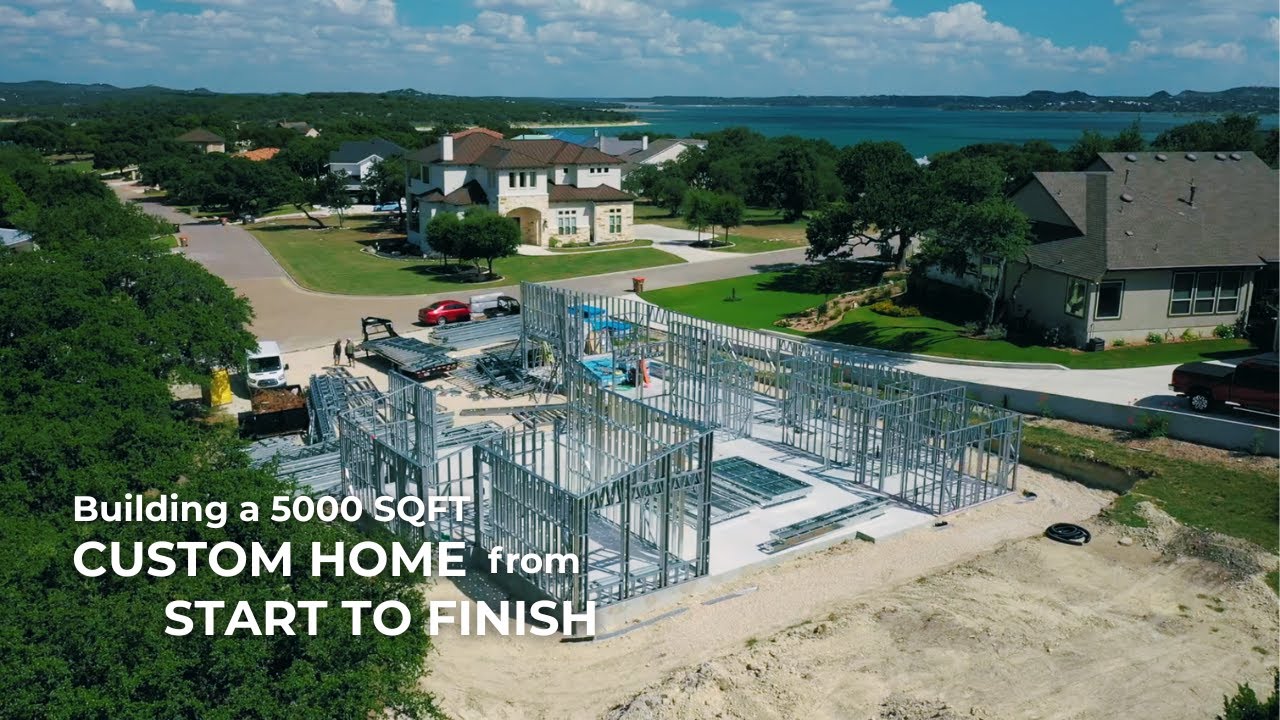
Steel doesn't burn. Proven.
Here's a 5,000 sqft fire-resistant home built on a panelized steel kit — the claim, on video, not just on paper.
 3:10
3:10
Questions, answered.
The things people most often ask before deciding between steel and wood framing.
-
Does cold-formed steel framing rust?
Cold-formed steel framing is galvanized — coated with zinc — to protect against corrosion. Inside a properly built and sealed wall assembly, galvanized CFS framing is rated for the full 100+ year design life. The same protective coating used in commercial steel construction.
The places where corrosion does matter — coastal humidity, direct moisture exposure — get heavier galvanization specs as part of the engineering scope.
-
Is steel framing more expensive than wood?
The framing material itself often costs more per pound. The total project cost is usually competitive — sometimes lower — once labor, waste, rework, insurance, and long-term maintenance are factored in.
Where the math tilts most clearly toward steel: small homes (precision matters more on tight footprints), multi-unit projects (the kit-of-parts logic scales), and high-risk insurance zones (the premium delta compounds annually). Run the numbers for your project →
-
Will my contractor know how to work with steel?
Most do — though the learning curve varies. The basics translate directly: studs, plates, headers, fasteners. The differences are good ones: fewer field cuts, no nails, screws instead of hammers, and a numbered drawing telling the crew exactly where each piece goes.
Trades from wood framing usually pick it up within a project. Some prefer it after their first build — less weight to handle, no warped studs, no sap.
-
Does steel framing conduct heat or cold?
Steel is more thermally conductive than wood, which means thermal bridging can be a concern if it isn't designed for. Properly insulated CFS wall assemblies use continuous exterior insulation — typically rigid foam outside the framing — to break the thermal path. The result is comparable or better than wood-framed walls of similar R-value.
Volstrukt frames are engineered with the insulation strategy in mind from the BIM model forward.
-
What about lightning strikes?
A steel-framed home is statistically safer in a lightning strike than a wood-framed home. The conductive frame provides a path for the current to dissipate to ground, similar to how a Faraday cage protects what's inside. Wood-framed homes are more likely to catch fire from a strike than steel-framed homes — not less.
-
Does cell signal work inside a steel-framed home?
Yes. CFS framing studs are spaced at 16" or 24" on-center with drywall in between — the same as wood. The frame doesn't form a continuous metallic envelope, so cellular and Wi-Fi signals pass through normally. If a specific room has signal issues (typical of any modern home with insulated walls), a Wi-Fi mesh or cellular signal booster handles it.
-
Is CFS framing approved by U.S. building codes?
Yes. Cold-formed steel framing has been a documented U.S. building material since 1925 (first used at the Virginia Baptist Hospital in Lynchburg) and a residential material since the 1933 Chicago World's Fair. It's covered by AISI S201 (the North American CFS framing standard), IRC Section R603 (residential code), and IBC for commercial. Every Volstrukt structural package is stamped by a licensed engineer in the project's jurisdiction.
-
How does Volstrukt fit into a CFS project?
Volstrukt designs and delivers the framing system as a precision-engineered kit. For a stock model, that's a defined scope and price. For a custom design, it routes through Build-Ready — submit drawings, receive a BIM model, cost estimate, schedule, and engineer-stamped package inside two weeks. Your architect stays your architect. Your contractor stays your contractor. We resolve the structure between them.
Now that you know the why.
Steel framing makes sense for more than one kind of project. Pick the path that fits what you're actually building.
ADUs & small homes
Stock models or custom designs. Engineered, kit-shipped, assembled fast. 400–800 sq ft typical.
Talk to our team →Custom homes
Long spans, floor-to-ceiling glass, century-grade structure. Architect-led design, Volstrukt structure.
Talk to our team →Build-Ready
Submit drawings, receive BIM model + cost + schedule + stamped package. Two weeks.
Talk to our team →Partner program
Embed Volstrukt systems into your products. Co-marketing, engineering support, #VolstruktInside.
Talk to our team →